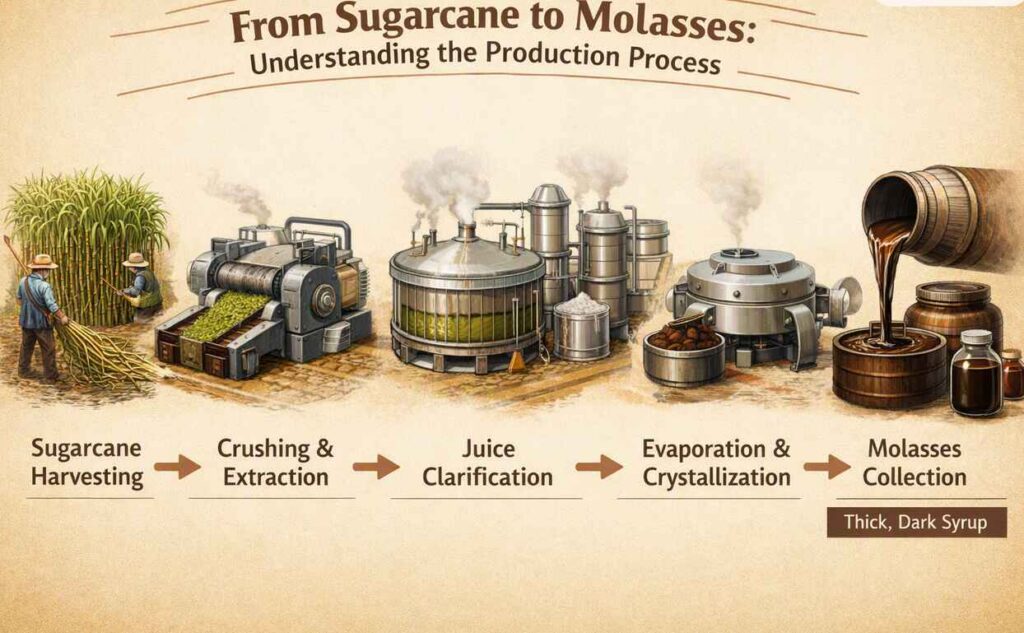
Molasses is a thick, dark syrup widely recognized for its distinctive flavor, rich color, and versatility. It is commonly associated with baking, food production, animal feed, fermentation, and several industrial applications. But where does molasses actually come from? The answer begins in sugarcane fields, where harvested cane undergoes a carefully controlled process that eventually produces both sugar and molasses.
Understanding how sugarcane becomes molasses provides useful insight into sugar processing and explains why this valuable by-product has so many applications.
What Is Molasses?
Molasses is a viscous syrup produced during the extraction and crystallization of sugar from sugarcane or, in some cases, sugar beets. Rather than being a simple waste material, molasses contains various compounds that remain after much of the sucrose has been removed in the sugar-making process.
Its composition can include residual sugars, minerals, organic compounds, and water. The exact characteristics of molasses depend on the source material, processing methods, and number of sugar crystallization cycles it undergoes.
Sugarcane molasses is particularly popular because of its deep color, strong aroma, and characteristic sweet-bitter flavor.
Step 1: Harvesting Sugarcane
The production process begins with mature sugarcane. Sugarcane is cultivated in warm climates because the plant requires sufficient sunlight, water, and a relatively long growing season to develop high levels of sucrose.
Once the cane reaches maturity, it is harvested mechanically or manually. Harvesting at the appropriate time is important because the amount of sucrose contained in the stalk directly influences the efficiency of sugar production.
After harvesting, the cane is transported to a sugar mill as quickly as practical. Delays can contribute to deterioration of the raw material and reduce the quality of the extracted juice.
Step 2: Crushing and Juice Extraction
At the sugar mill, the sugarcane is cleaned and prepared for processing. The stalks are then chopped or shredded into smaller pieces to make juice extraction more efficient.
The prepared cane passes through a series of heavy rollers or milling equipment. Mechanical pressure breaks down the plant material and extracts the sweet juice contained inside the stalks.
The remaining fibrous material, known as bagasse, can also have value. Many sugar mills use bagasse as a fuel source to generate steam and electricity for their operations.
The extracted cane juice contains sucrose along with water, plant compounds, minerals, and other substances that need to be removed or reduced during subsequent processing.
Step 3: Clarifying the Cane Juice
Fresh sugarcane juice is not ready for sugar crystallization. It contains suspended solids, plant particles, and other impurities.
During clarification, the juice is heated and treated using appropriate processing methods to separate unwanted materials. The impurities form a concentrated material that can be removed, leaving a cleaner sugar solution.
Proper clarification improves the efficiency of the following stages and helps produce better-quality sugar.
Step 4: Evaporation and Concentration
After clarification, the juice still contains a significant amount of water. The next stage involves evaporation, where water is removed through controlled heating.
As the water evaporates, the juice becomes increasingly concentrated and develops a thicker consistency. This concentrated liquid contains a high proportion of dissolved sugars.
Modern sugar factories often use multiple-effect evaporators to improve energy efficiency. Steam generated during one stage can be reused in another, reducing overall energy consumption.
Step 5: Sugar Crystallization
The concentrated syrup is then processed to encourage sugar crystals to form. Under controlled conditions, sucrose separates from the surrounding liquid and forms crystals.
The sugar crystals are separated from the remaining syrup using equipment such as centrifuges. The separated crystals can undergo additional processing to produce refined or raw sugar, depending on the production system.
However, not all of the sugar can be crystallized and recovered. The remaining thick syrup is where molasses begins to emerge as a distinct product.
Step 6: Producing Molasses
Molasses is essentially the residual syrup left after sugar crystals have been removed. Depending on the manufacturing process, the syrup may pass through several crystallization cycles.
Each cycle extracts additional sucrose. As more sugar is removed, the remaining syrup becomes darker, thicker, and richer in compounds that do not readily crystallize.
The number of crystallization stages influences the type and characteristics of the resulting molasses. For example, lighter molasses generally comes from earlier stages, while blackstrap molasses is associated with later stages of sugar extraction and contains less sucrose than earlier molasses streams.
Different Types of Molasses
Not all molasses is identical. Its properties vary according to how it is produced and how much sugar has been extracted.
Light molasses is generally produced during earlier stages of sugar crystallization. It tends to have a lighter color and milder flavor.
Dark molasses results from further sugar extraction and typically has a stronger taste and darker appearance.
Blackstrap molasses is produced after multiple stages of crystallization. It is especially known for its dark color, strong flavor, and relatively high concentration of certain minerals.
Molasses can also be categorized according to its intended application, including food-grade, feed-grade, and industrial products.
Common Uses of Molasses
Molasses has applications far beyond traditional food production. In the food industry, it can be used as a sweetener, flavoring ingredient, and coloring agent in products such as baked goods, sauces, cereals, and marinades.
It is also widely used in animal feed because its sugars can provide an energy source while its flavor may improve feed palatability.
Another important application is fermentation. Molasses contains fermentable sugars that can serve as a feedstock for producing products such as ethanol, yeast, and other fermentation-derived materials.
In agriculture and industry, molasses may also be used in various formulations and processing applications, depending on its composition and quality.
Why Molasses Is an Important Sugarcane Product
The production of molasses demonstrates how sugar processing can generate multiple valuable products from a single agricultural crop. Sugarcane does not simply produce table sugar; its different components can contribute to energy generation, animal feed, fermentation, and industrial applications.
Using molasses also supports more efficient utilization of sugar-processing resources. Instead of treating the residual syrup solely as waste, producers can collect, process, store, and distribute it for different markets.
Conclusion
From sugarcane fields to processing mills, molasses is the result of a carefully managed sugar production process. Sugarcane is harvested, crushed for its juice, clarified, concentrated, and processed through repeated crystallization. When sugar crystals are separated, the remaining concentrated syrup becomes molasses.
Its unique combination of sugars, minerals, flavor compounds, and other components makes molasses a versatile material with applications in food, animal feed, fermentation, agriculture, and industry.
Understanding the journey from sugarcane to molasses highlights the complexity of sugar production and the importance of making full use of agricultural resources. What may appear to be a simple dark syrup is actually the result of several interconnected processing stages—and a valuable product in its own right.
This article made by: https://moltaraindo.com