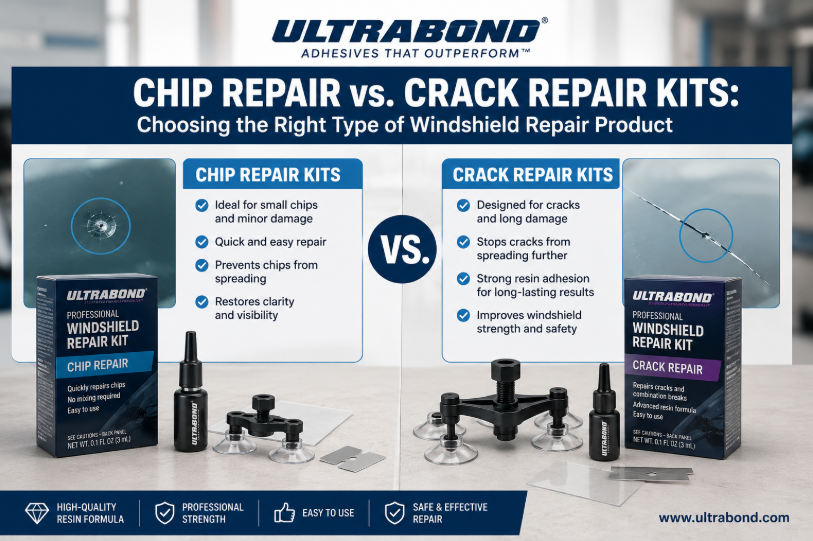
Chip damage and crack damage in windshields require different repair approaches and different materials. Using a chip repair kit on a crack, or a crack repair kit on a small chip produces inferior results regardless of product quality. The windshield repair category includes products designed for specific damage types. Matching the product to the damage is the first decision in any repair.
Chip Repair Kits, Explained Simply
A chip repair kit is designed for contained impact damage: bullseye chips, star breaks, and combination breaks where the primary damage is concentrated in a small zone rather than propagated along a crack line. Chip repair resins are typically formulated at higher viscosity to fill cavities and displaced material zones. The injector systems in chip kits are designed to seat directly over the impact point and create a sealed injection chamber.
Crack Repair Kits, Explained Simply
A crack repair kit addresses linear damage that extends from a point of impact or from the edge of the glass. Crack repair resins are formulated at a lower viscosity to flow into narrow crack channels. The application involves bridge-style injectors that can be repositioned along the crack length or capillary application directly into the crack opening. The goal is to fill the full length of the crack with void-free resin.
The Auto Glass Safety Council classifies windshield damage into repairable and non-repairable categories based on size, location, and type. Chips up to one inch in diameter and cracks up to six inches in length in the peripheral vision area are generally repairable with appropriate products and technique, while cracks in the driver’s direct line of sight may require replacement regardless of repair quality.
When to Use Which
Use a chip repair kit for any damage that is primarily contained: bullseye chips, star breaks, and combination breaks under one inch in diameter. Use a crack repair kit for any damage that has propagated linearly, regardless of whether it started as a chip. Damage that includes both an impact zone and a propagating crack requires crack repair treatment of the linear portion and chip repair treatment of the impact zone, in that order.
Common Mistakes in Both
- Attempting to repair a crack longer than six inches, which exceeds the structural repair threshold in most guidelines.
- Using a chip repair injector on a linear crack, which leaves the crack channel unfilled.
- Using a low-viscosity crack resin on a deep chip cavity, which may not fill the full cavity volume.
- Repairing windshield damage in the driver’s primary sightline without confirming it meets repairability criteria.
Research by the National Windshield Repair Association indicates that damage type misclassification, specifically attempting chip repair on crack damage or vice versa, is responsible for approximately 25 percent of consumer windshield repair kit failures where the product itself was of adequate quality.
Final Thoughts
The best windshield crack repair kit for your specific damage is the one designed for the actual damage type you have. Classify the damage accurately first, then select the product designed for that damage type. Product quality and technique both matter, but matching the product to the damage type is the prerequisite that makes both of them relevant.